Moving ore and overburden
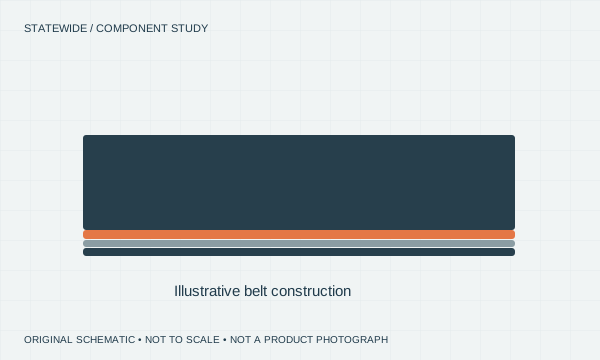
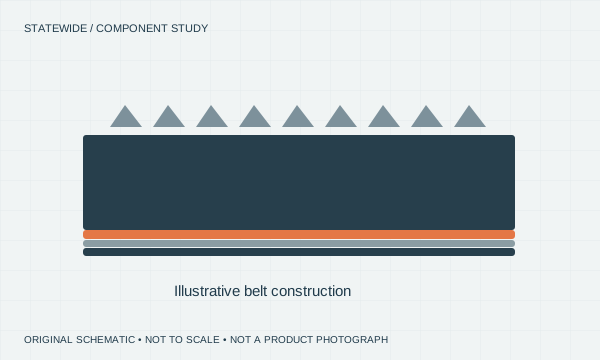
Mine conveyors may carry heavy, uneven loads over long routes with multiple transfers. Belt selection needs the operating tension, duty cycle, lump size and condition of the material—not just the nominal belt width. Existing drawings and manufacturer specifications help establish the replacement requirements.
Protect the loading zone
Repeated impact and trapped rocks can damage both covers and reinforcement. Review feed direction, impact support, skirt clearance and the condition of surrounding steelwork. A stronger belt cover cannot compensate for a loading arrangement that continually cuts the belt edge.
Plan work around plant access
Large belt rolls, restricted transfer towers and extended conveyor routes affect lifting, pulling and jointing arrangements. Condition assessments and maintenance planning can group belt, roller and pulley work into a defined shutdown. Underground, fire-resistant or other regulated applications require project-specific specifications and confirmation of suitability.
Mining applications: establish the operating duty
Heavy loading points
Impact and cutting from uneven feed
Review the belt carcass, cover and loading support as one requirement.
Long conveyor routes
Tracking varies between loading states
Locate the first point of drift and inspect feed, rollers and pulley condition.
Transfer towers
Restricted belt and component access
Plan joint position, belt handling and removal paths before the shutdown.
Separate belt condition from the replacement specification
Record the existing belt designation and available manufacturer data, then describe where and how it is failing. The same width does not establish equivalent strength, construction or operating suitability. Requirements for fire resistance or regulated applications must be specified and confirmed for the particular site.
Explore suitable products and support
Tell us about your operation
- Surface or underground application and specified belt standard
- Belt construction, strength, dimensions and conveyor length
- Material characteristics, loading points and observed damage
- Site access, lifting arrangements and planned outage