Select the cover for the material, the carcass for the load and the configuration for the conveyor. Compare the rubber-belt families below before preparing a specification.
Supply and replacement options are reviewed against your specification. Specialist configurations and availability require confirmation with your quotation.
Rubber-belt categories
Belting / 01
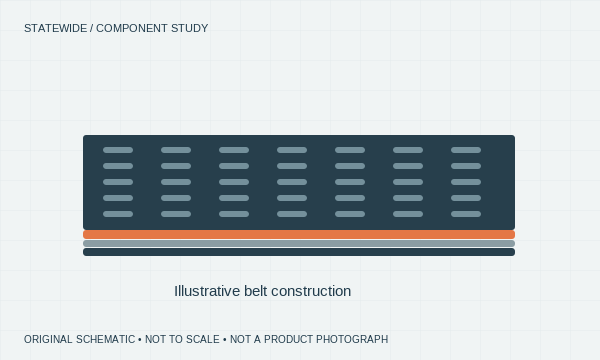
General-purpose rubber belting
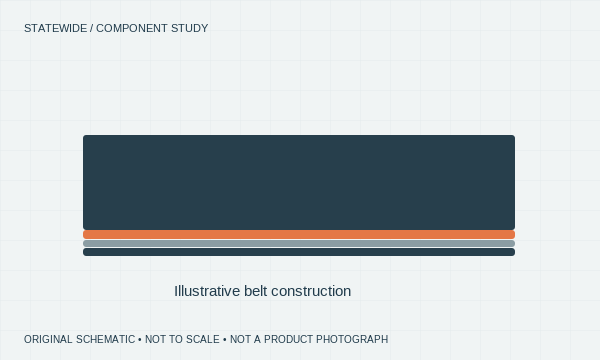
A smooth rubber carrying cover over a tension-bearing carcass provides the starting point for conventional bulk conveying. Cover compound and carcass are specified separately.
- Typical applications
- Sand, aggregates and general dry bulk transfers without a special chemical or temperature requirement.
- Construction & options
- Textile-reinforced constructions and smooth covers; the number of plies and cover thickness depend on the selected belt.
- Selection & replacement
- Provide working tension, trough geometry, belt width, speed and smallest pulley. A thicker cover is not a substitute for the correct carcass.
Belting / 02
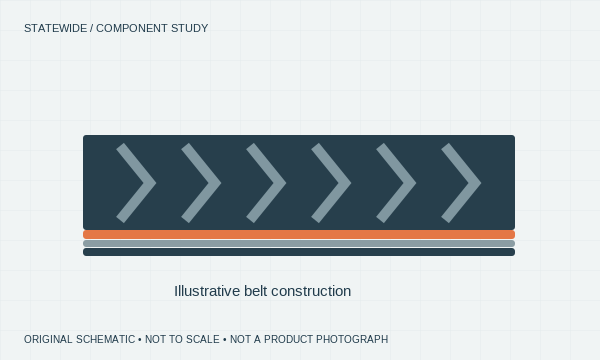
Chevron / profile rubber belting
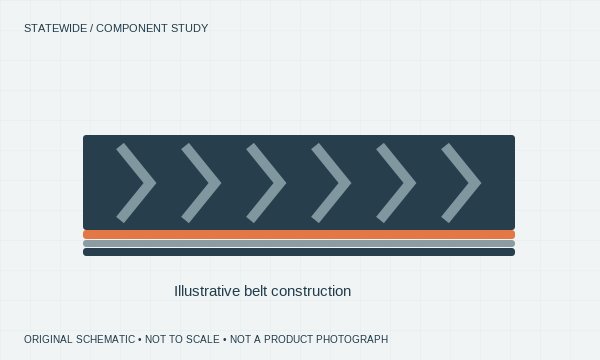
Raised chevrons help retain loose material where an ordinary flat surface allows rollback. The pattern also changes return-run support and cleaning.
- Typical applications
- Inclined aggregate, agricultural-product and recycling transfers where the material can release from the profile.
- Construction & options
- Moulded chevron configurations are offered by belt manufacturers. Pattern height and usable width must be checked against the chosen construction.
- Selection & replacement
- Send incline, material size and moisture, pulley diameters and return-roller layout. There is no single maximum incline for every material.
Belting / 03
Abrasion-resistant belting
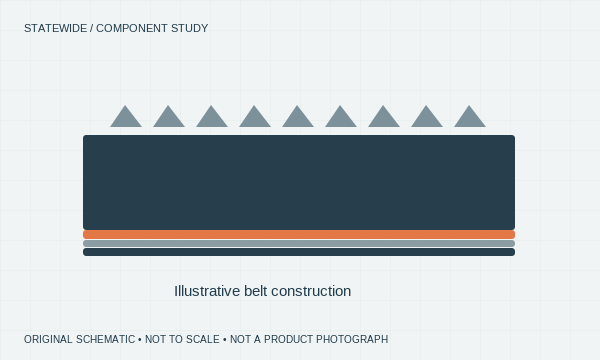
Wear-resistant covers address progressive loss of rubber caused by abrasive contact. Cut and gouge resistance is a separate consideration when sharp lumps strike the belt.
- Typical applications
- Crushed stone, sand and mineral-processing transfers.
- Construction & options
- Cover compounds with manufacturer-declared abrasion properties, matched to textile or other specified reinforcement.
- Selection & replacement
- Describe whether the failure is surface wear, a deep cut or carcass damage. Compare the proposed compound data and loading conditions before ordering.
Belting / 04
Heat-resistant rubber belting
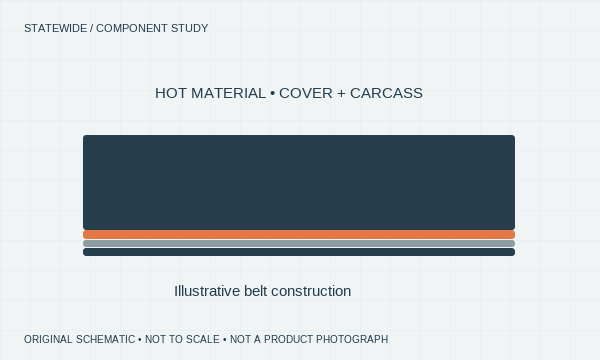
Heat-resistant compounds and a compatible carcass are selected as a complete belt system. Material temperature alone does not describe the temperature reached by the belt.
- Typical applications
- Hot mineral, cement-process and foundry transfers where the conveyor arrangement is suitable.
- Construction & options
- Heat-duty covers and reinforcement selected from the chosen manufacturer’s range; no universal temperature rating applies.
- Selection & replacement
- Record continuous and peak temperatures, lump versus fines content, contact time and cooling on the return. Confirm the splice materials for the same duty.
Belting / 05
Oil-resistant rubber belting
Oil exposure can soften or swell an unsuitable rubber cover. Selecting the compound requires identification of the actual oil and its contact conditions.
- Typical applications
- Oily recycling streams, timber residues and handling of products containing fats or oils.
- Construction & options
- Compounds intended for vegetable or animal oils differ from those intended for mineral oils. Resistance must be checked for the exact contaminant.
- Selection & replacement
- Identify the oil, concentration, temperature and duration of contact. Supply a sample or material information when the waste stream is mixed.
Belting / 06
Fire-resistant / fire-retardant belting
A specified fire-performance belt is chosen against the installation’s requirements and supporting test documentation. Fire resistance does not mean a belt is fireproof.
- Typical applications
- Enclosed or regulated installations where the equipment specification calls for controlled fire behaviour.
- Construction & options
- Manufacturer-tested constructions may combine fire and other properties. Antistatic performance and underground suitability require separate confirmation.
- Selection & replacement
- Provide the exact required standard and application. Certification must cover the supplied belt and agreed splice; no blanket compliance claim is made here.
Belting / 07
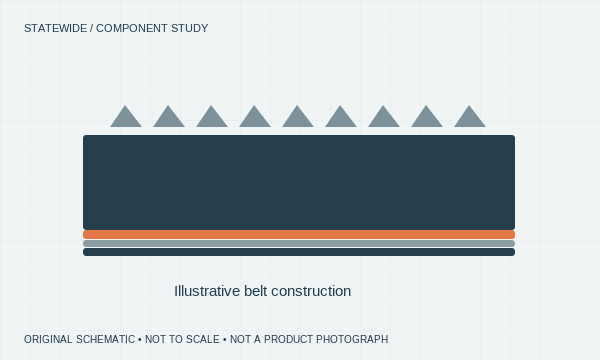
Cleated and sidewall belting
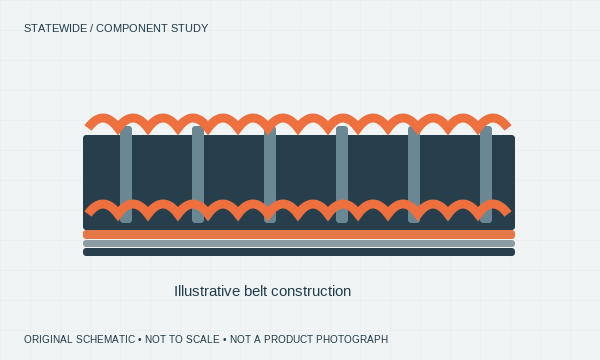
Transverse cleats move material in pockets while corrugated sidewalls provide edge containment. The base belt, walls and cleats must flex together around the conveyor.
- Typical applications
- Steep elevation changes and contained transfers where a conventional troughed belt will not fit the route.
- Construction & options
- Compatible base belts with selected cleat and wall arrangements, subject to the fabricator’s design.
- Selection & replacement
- Supply the complete route, pulley and deflection arrangements, material size and pocket loading. Check discharge release and return clearances.
Belting / 08
Reinforced and cut-resistant options
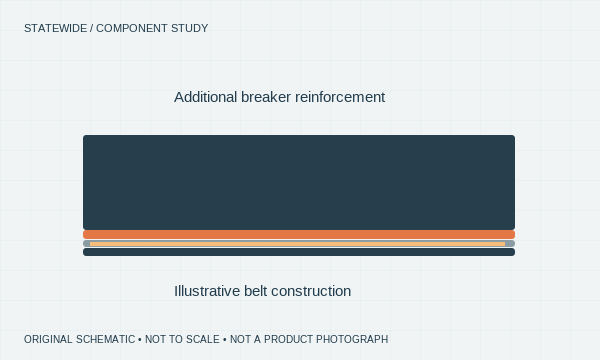
Additional reinforcement can help address particular impact or tear mechanisms. It must be selected around the likely damage rather than assumed to prevent every puncture.
- Typical applications
- Sharp recycled material, coarse feed and difficult loading points.
- Construction & options
- Textile carcasses with optional breaker reinforcement; steel-cord constructions require a separate engineering and sourcing review.
- Selection & replacement
- Describe the damage location and impact source. Confirm pulley compatibility, troughability and joint design before substituting a different construction.
Specify the complete belt
Send the conveyor drawing or current belt data sheet, finished length and width, working tension, cover requirements and joint method. Include the smallest pulley and any reverse bends. Replacement selection should check both the operating duty and the installation.
Enquire about rubber conveyor beltingRelated products & services
Technical references
Manufacturer information used to check product categories. These links do not imply a distributor appointment or a supply partnership.